


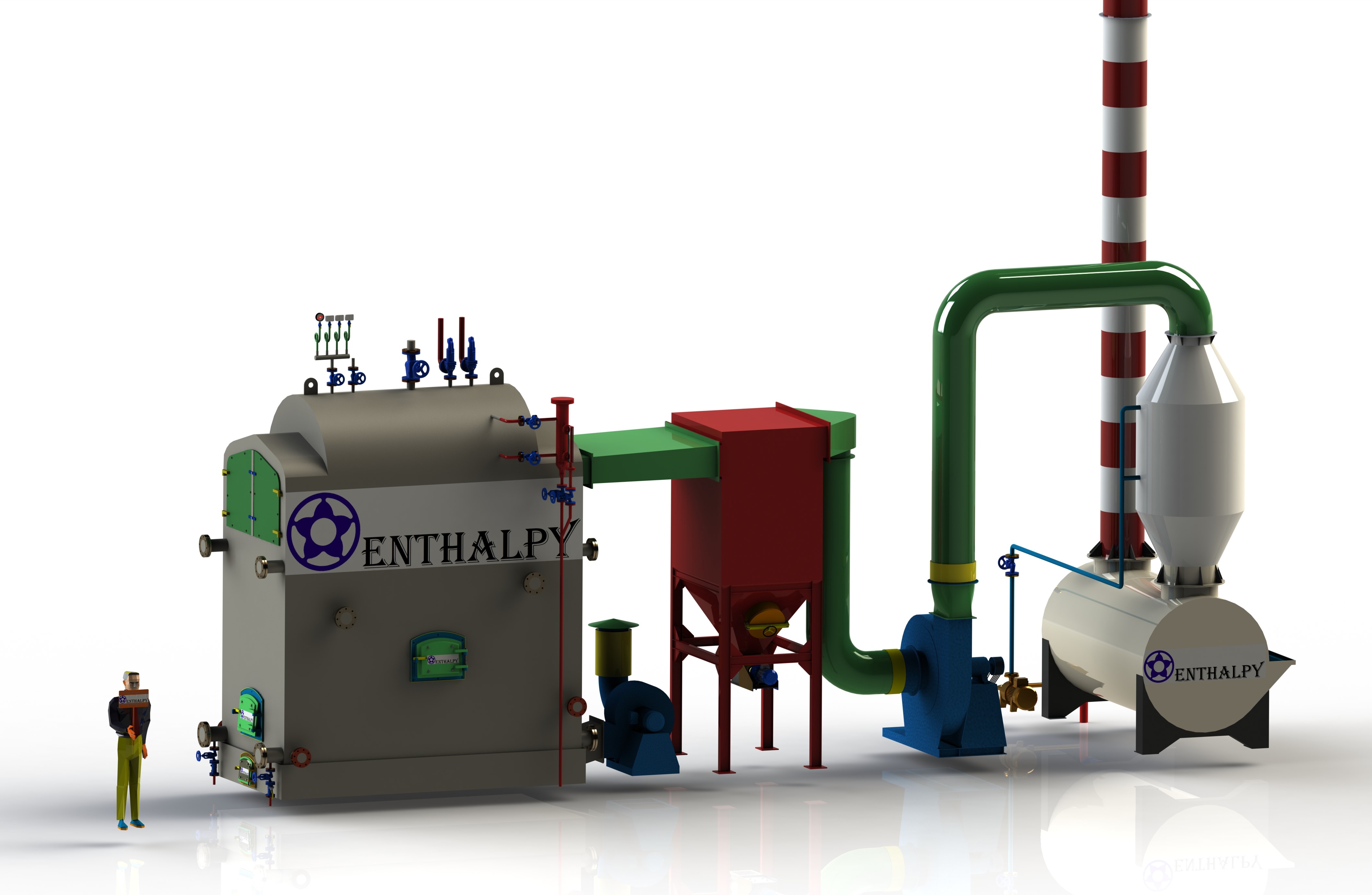
Introduction to the Hand-Fired Grate Boiler (also known as a fixed grate boiler, and commonly called a wood-fired, lump coal-fired, paper or textile waste-fired boiler in factories)
The hand-fired grate boiler / fixed grate boiler / wood-fired boiler has a furnace in which the fuel burns in a stationary bed on the grate surface. This boiler can fire several fuels at the same time, such as lump coal, rice husk briquettes, firewood, etc.
The main components and equipment of the hand-fired grate boiler are as follows:
Furnace section:
- Grate: made of high-temperature-resistant cast iron in various special designs such as bar grates, perforated plate grates, dumping grates and step grates, suitable for fuels such as lump coal, firewood, rice husk briquettes, etc.
- Furnace brickwork: specially designed and built to ensure stable, long-term operation and to improve fuel burnout efficiency in the furnace.
- Radiant heating surface: made of special heat-resistant seamless steel boiler tubes. It absorbs the radiant heat released directly by fuel combustion in the furnace.
- Ash and slag removal: an ash screw conveyor mechanizes ash and slag removal, minimizing manual labor during boiler operation.
- In addition, to make operation as convenient as possible, Enthalpy boilers are researched, designed and manufactured with operating doors arranged in the most practical way. Cleaning doors and header blowdown points are positioned for the easiest possible maintenance and servicing.
Convection section – boiler body:
The convection section is a bi-drum tube bank design with one steam drum and one water (mud) drum. The steam drum is fitted with a steam–water separator and all process connections such as the main steam valve, safety valves, air vent valve, feedwater line, water level gauge glass, control signal assembly, etc. The water drum is fitted with a bottom blowdown pipe and valve.
The entire boiler body is designed, manufactured and inspected in accordance with the highest procedures and standards such as TCVN and ASME.
Dry dust collector:
With particular attention to environmental protection, this type of boiler uses a multi-cyclone dust collector. The multi-cyclone uses centrifugal force to separate dust particles, capturing more than 90% of the fly ash carried in the flue gas.
Wet scrubber:
After the flue gas leaves the multi-cyclone, all Enthalpy boiler systems are equipped with a Venturi scrubber to ensure thorough treatment of emissions.
The effectiveness of the combined dust collector and wet scrubber system has been proven in actual operation at plants and in areas with the strictest environmental requirements, meeting all environmental standards currently in force in Vietnam.
Boiler electrical and control system:
Switching and protection devices:
- All electrical equipment of the boiler is provided with automatic switching and protection against overload, overcurrent, short circuit, phase reversal, phase loss, etc.
Instrumentation and control:
- This is the most important part for controlling and regulating the boiler auxiliary equipment. It includes the following:
+ Level control: this unit measures the water level in the boiler and processes the signal to issue control commands.
- Start the feedwater pump to make up water according to the steam demand of production.
- Stop the feedwater pump when the water level in the boiler is sufficient.
- Temporarily stop certain equipment when the water level drops below normal (low water level, stage 1), ignoring transient faults and false alarms, and alert the operator with an indicator lamp to correct the fault.
- Trip or reduce the speed of related equipment such as the induced draft fan and forced draft fan to reduce the heat input to the boiler, and give a red lamp alarm when the water level falls to a critical point (low-low water level, stage 2).
- Pressure and temperature control: this unit measures the pressure and temperature in the boiler and processes the signals to issue control commands interlocked with the level controller, regulating the speed of the induced draft fan, forced draft fan and feedwater pump according to the load, or giving early warning by signal lamps and horns of possible fault conditions related to pressure and temperature.
Boiler feedwater treatment system:
- The boiler is equipped with a water softening system and a chemical dosing system to prevent scale formation and foaming.
Advantages of the hand-fired grate / fixed grate / wood-fired boiler:
- Lower investment cost than other solid fuel boilers of the same capacity.
- Simpler equipment means fewer breakdowns, so maintenance costs are also lower than other solid fuel boilers of the same capacity.
- Thanks to the design of the fuel feeding system and furnace grate, the wood-fired boiler can co-fire other fuels such as rice husk, sawdust, biomass, rice husk briquettes, sawdust pellets, lump coal, etc.
- Lower power consumption, as it does not require high-pressure fans like a fluidized bed boiler, nor several items of equipment that are mandatory on fluidized bed boilers, such as fuel feeding air fans, ash recirculation fans and secondary air fans.
- Relatively simple operation compared to other boiler types.
Disadvantages of the hand-fired grate / fixed grate / wood-fired boiler:
- The first and most important disadvantage is the capacity limit. Since fuel is usually fed into the furnace manually, a large capacity means a very large amount of fuel must be fed by hand every hour to keep the boiler running. Hand-fired grate boilers are therefore generally recommended only for capacities below 8 tonnes of steam per hour.
- The second drawback is flue gas emissions. During firing-up at boiler start-up, combined with the moisture in the fuel, black smoke is often discharged from the stack, affecting the surrounding environment.
Operating notes for the hand-fired grate / fixed grate / wood-fired boiler:
Walk around the boiler regularly and check the following points periodically:
- Check the softened feedwater regularly.
- There is no excessive noise from fan motors or any other moving parts.
- All valves and joints are free of leaks.
- No part of the boiler is overheated.
- The feedwater pump operating in on-off mode confirms that the level control is functioning, and an adequate water flow is maintained.
- The stack emissions are normal.
- There is no electrical arcing or loose contact in the electrical circuits.
- All controls and safety devices are fully operational.
- Steam pressure and water level are kept stable within the required range.
- There is no over-firing of fuel in the furnace.
- The boiler is blown down regularly. The blowdown frequency depends on the quality of the boiler water.
- Blow down the level control switch and the water level gauge glass once per shift.
- Drain a small amount of water from the feedwater tank once per shift to remove any settled sludge.
- Record the flue gas outlet temperature.
- Maintain the furnace pressure between -2 and -5 mmH2O by adjusting the ID fan inlet guide vanes (damper).
- Ensure the flue gas outlet temperature is within the range required for the load. If it is high, check for fouling of the heating surfaces or obstruction of the flue gas path.
- Check that the motor currents of fans, pumps, etc. stay within their limits and record them in the operating log.
- Ensure there is no air ingress at the stack outlet.
- Ensure the correct fuel size, that the fuel contains no foreign objects such as metal pieces or stones, and that the fuel feeder does not malfunction during operation.
- Check and ensure that smoke and fly ash inside the boiler house are kept to a minimum.
- Ensure that all boiler operations, including chemical dosing and blowdown, are accurately recorded in the operating log.
Maintenance of the hand-fired grate / fixed grate / wood-fired boiler:
To ensure that the boiler system operates efficiently and safely, and to maintain occupational safety and hygiene in the plant, the user must strictly follow the boiler maintenance procedures recommended by the boiler supplier. Particular attention should be paid to the following points:
- Boiler efficiency depends greatly on proper maintenance. The boiler, its surroundings, water piping, strainers, etc. should be kept clean so that the correct amount of water is supplied to the boiler and it operates at high efficiency.
- To make it easy to detect faults and deviations from the reference values under normal operating conditions, operating readings should be recorded, and recorded again after every major overhaul or parts replacement.
- Maintenance work should be recorded in daily, weekly and monthly logs. This is essential for verifying that all parts of the boiler are working correctly.
- Maintenance inspection records should be kept, preferably in the boiler operating log.
The operator must have a checklist of daily, weekly, monthly, quarterly and annual maintenance tasks, in accordance with the documentation provided by the boiler supplier.
Preservation during shutdown of the hand-fired grate boiler
This section provides key information on laying up the boiler for an extended period.
- If the boiler is shut down for 1 month or longer, use the dry lay-up method.
- If the boiler is shut down for less than 1 month, use the wet lay-up method.
Dry lay-up method:
- After shutdown, drain all water from the boiler. Open the drum manholes, open the valves and remove the header handhole covers. Clean the scale inside the drums, tube banks and headers, then dry them with a small fire (do not use a large fire).
- Place 25–30 kg of quicklime with a lump size of 10–30 mm in aluminum trays inside the drum. Close all boiler doors and valves. Check every 3 months and replace the quicklime if it has turned to powder.
Wet lay-up method:
- After shutdown, drain all water from the boiler, then flush and clean the scale inside.
- Fill the boiler completely with water and fire it to gradually raise the boiler water temperature to 100oC.
- While firing, open the air vent valve or lift the safety valve to release gases so that the boiler does not build up pressure.
- Stop firing, then close the air vent valve or safety valve.
For more information or to equip your plant with a boiler, please contact Enthalpy for free consultation and the most suitable product at the best investment cost.
1. Boiler type: Fixed grate, combined water-tube and fire-tube, single-drum boiler with natural circulation.
2. Fuel: Firewood, rice husk briquettes, lump coal, etc.
3. Fuel size: 10 - 400 mm.
4. Power supply: 3-phase, 380 V, 50 Hz
5. Operating mode: Automatic feedwater supply, automatic start/stop of combustion air, and automatic flue gas draft control according to pressure.
6. Manufacturing standards: TCVN 7704:2007; TCVN 6413:1998; TCVN 8366:2010; or ASME standards, etc.
7. Environmental standards: Noise level below 85 dB at 1 m from the boiler house; flue gas emissions in compliance with QCVN 19:2009/BTNMT (Vietnamese National Technical Regulation on Industrial Emissions of Dust and Inorganic Substances).
8. Main technical specifications: